Custom Sliver C2-Framework
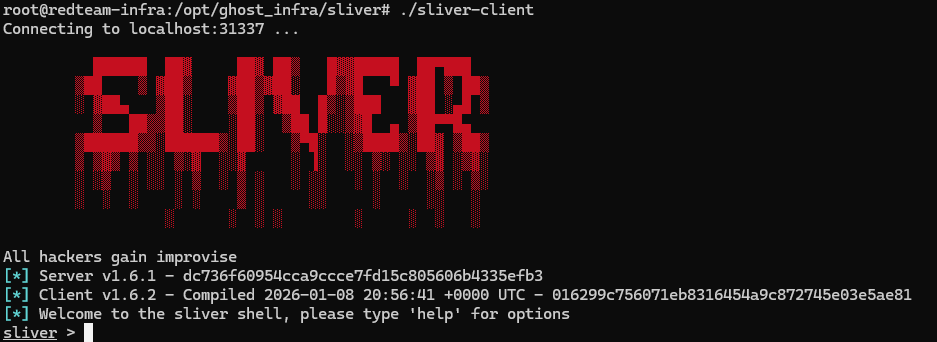
Customized Sliver C2-Framework running on a hardened VPS with Serverless Redirector
Automated & Hardened C2 Infrastructure
In modern Red Teaming, infrastructure must be disposable, reproducible, and stealthy. For this project, I engineered a fully automated Infrastructure as Code (IaC) pipeline using Ansible to deploy a highly customized Sliver C2 server.
The objective was to move away from default binaries and build a custom-compiled infrastructure optimized for cost-effective ARM64 cloud instances, protected by serverless edge redirectors to mask the backend origin and evade detection. This is a VERSION 2 of my project and the V3 will move towards Terraform and the Cloudflare worker will be replaced by tool called Ligolo-ng.
Status: Operational / Fully Hardened
Tech Stack: Ansible, Go (1.23+), Cloudflare Workers, Linux (Debian), Sliver, Systemd Sandboxing
Project Highlights
This pipeline orchestrates source code mutation before compilation and implements multi-layer network obfuscation.
- Polymorphism: Automated source-code injection for unique binary hashes and randomized database artifacts.
- Stealth: Serverless Edge Redirectors (Cloudflare Workers) for origin IP masking and granular traffic filtering.
- Hardening: Static analysis resistance via
-trimpathand strict Systemd process sandboxing.
Technical Deep Dive
1. Polymorphic Infrastructure (Anti-Forensics)
Standard C2 installations leave predictable artifacts like sliver.db. My Ansible playbook acts as a pre-compiler modification engine to break static signatures and forensic patterns:
- Source Code Mutation: The playbook uses
sedto inject random strings into the Go source code, renaming the core database (e.g.,core_oohhukam.db) and internal structures. - Service Randomization: The Systemd service is deployed with randomized names (e.g.,
sys-yotipt.service), blending into standard background system processes. - Binary Stripping: All binaries are compiled with
-ldflags="-s -w"and-trimpath, removing debug symbols and build-machine path metadata that could leak developer environment details.
2. Serverless Edge Redirectors (Cloudflare Workers)
To prevent direct exposure of the C2 server's IP address, I implemented a Serverless Redirector using Cloudflare Workers. This layer acts as an intelligent proxy and the primary line of defense.
- Traffic Blending: The redirector is configured to allow only specific paths (e.g.,
/js/jquery.min.js), mimicking a legitimate JavaScript CDN. - Request Filtering: Any unauthorized access or scanning attempts are met with a
403 Forbiddenor a302 Redirectto a decoy site, preventing backend fingerprinting. - Origin Masking: The implant only communicates with the edge domain, making it virtually impossible for blue teams to identify the backend VPS IP without edge-level logs.
3. Operational Hardening via Systemd
The C2 server runs in a highly restricted Systemd Sandbox. Instead of root privileges, the process is managed by a low-privileged user (sliver-svc) with zero interactive login capability.
NoNewPrivileges=true: Enforces that the process and its children can never gain new privileges via suid bits.PrivateTmp=true: Provides an isolated, non-persistent/tmpnamespace.ProtectHome=true: Ensures the service cannot access any user home directories, limiting the impact of a potential process compromise.
4. ARM64 Compilation & Traffic Masquerading
The server is optimized for ARM64 architecture, utilizing architecture-specific build tools and -tags "cgo_sqlite" for database stability. The C2-server is further hardened with HTTP Masquerading, where the backend server headers are spoofed to return Server: cloudflare, ensuring perfect header symmetry with the redirector layer.
MITRE ATT&CK® Mapping
Technical Validation (Proof of Hardening)
To verify the efficacy of the hardening measures, I performed technical checks on the production binary. The following evidence confirms the absence of symbols, path metadata, and the successful deployment of the polymorphic database.

Figure 1: Terminal verification showing no symbols (nm), zero path leaks (strings), and custom DB artifacts.
# Manual verification commands:
$ nm sliver-server | grep "sliver" # Expected: no symbols
$ strings sliver-server | grep "/opt/" # Expected: empty
$ ls /opt/Ghost-Sliver/sliver/.sliver/*.db # Expected: core_[random].db
Conclusion
This project demonstrates that effective Red Teaming infrastructure requires a blend of offensive security research and defensive DevOps principles. By combining Infrastructure as Code, Source Mutation, and Serverless Edge Computing, I created a C2 environment that is resilient against both network-based heuristics and host-based forensic analysis.
Continue to Part II
The infrastructure is built, but now it needs a gatekeeper. In the next part, I deploy a Smart Serverless Redirector to make the backend completely invisible.